
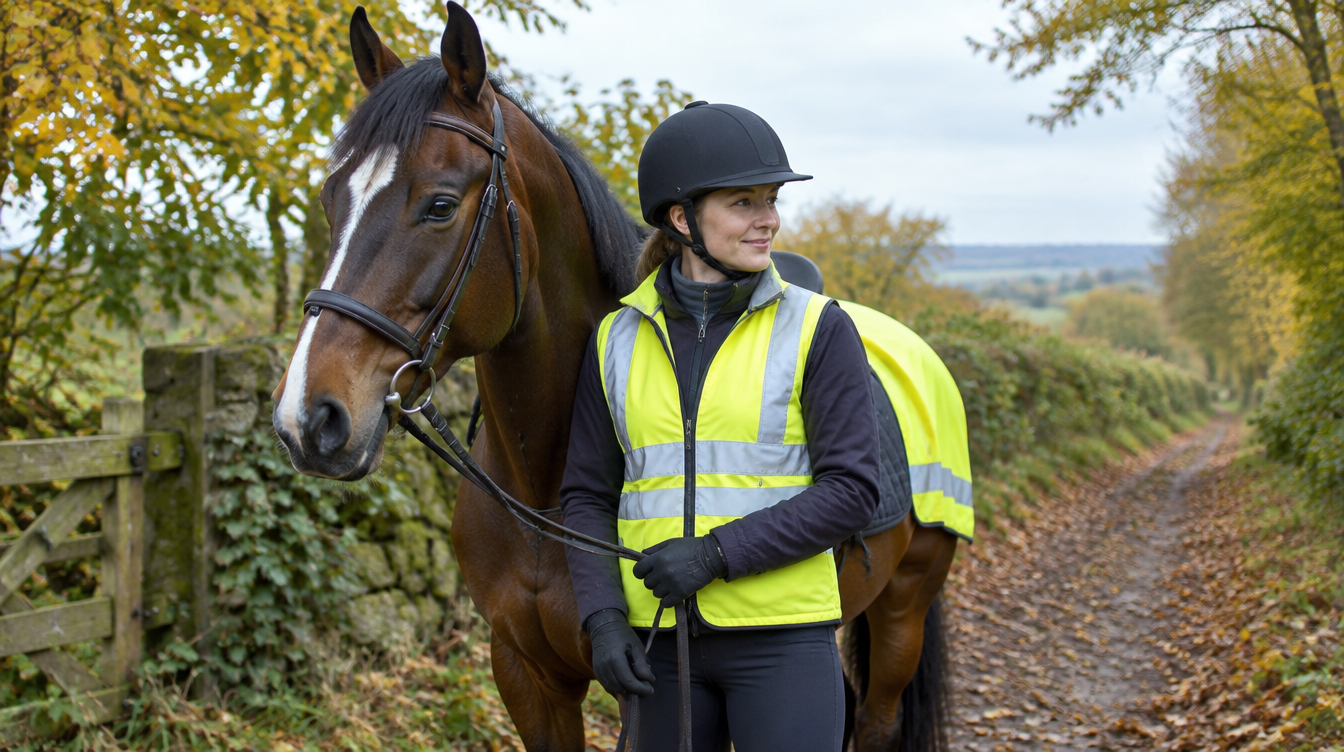
Featured image: AI-generated editorial illustration, not camera footage or product photography.
Quick answer: Choose a horse-riding camera around the view you want and a fitting method permitted for your equipment. Compare weight, operation, tested runtime and file access after that. A compact forward camera and a front-and-rear unit perform different jobs. No camera attachment should be assumed suitable for every riding hat, and no recording guarantees a particular reporting outcome.
A good hack needs enough preparation without turning camera setup into a second discipline. You want the equipment ready, the horse settled and the ride to remain the reason you went out.
That is why the best camera decision starts with a simple question: what would you find useful to look back on? A record of the lane ahead, approaching traffic behind or both can each be a sensible answer. The important thing is choosing deliberately rather than collecting features you cannot explain.
Begin with your normal riding situation
Think about road sections, bridleways, shared routes and the duration of an ordinary outing. You do not need an invented worst-case story to justify wanting a record.
A rider who spends most time on lanes may value footage of traffic approaching from behind. Another may want a small forward view of familiar routes. Someone taking longer hacks may need a different charging plan.
Separate those needs from the desire for smooth cinematic footage. Recording a useful view of the surroundings is a different buying priority from producing an edited action film.
Front, rear or both?
A forward camera records within its view ahead. It can show the route, road layout and approaching traffic in that direction. It may miss the approach of a vehicle behind you.
A rear view records a different part of the journey. Front-and-rear cameras combine the two directions, adding context where a situation moves between them.
Two views still leave blind spots. The rider, horse, clothing, tack and surroundings can obscure information. A riding-hat camera moves with the rider’s head, so its perspective changes during normal observations. No camera records everything the rider experiences.
Riding-hat compatibility is a separate question
Check the current instructions from the manufacturer of your particular riding hat before attaching a camera or mount. A supplied camera strap is not blanket approval for all protective headgear.
Do not drill, cut or modify the hat. Do not assume a different adhesive, a tighter strap or an arrangement copied from a photograph solves a compatibility concern. Ask the hat manufacturer when its instructions are unclear.
Camera attachment should not compromise fit, vision, normal movement or the protective equipment’s intended use. The suitability question comes before the camera angle, not after choosing a position that looks impressive.
Consider suitable alternatives carefully
If a hat attachment is not permitted, a body-worn arrangement may be worth discussing where the camera and equipment manufacturers support it. It is not automatically an acceptable workaround.
Consider snagging, movement and interference with reins, clothing or tack. A lower viewpoint may be obscured by arms or riding position. Do not attach equipment to the horse or tack based on an improvised idea for a better shot.
Use suitable professional advice for your equipment and riding needs. Make a test recording only after the fitting itself is appropriate, and review it while safely stopped.
Which current Techalogic models are relevant?
HC-1 is the small forward-recording option, with a stated camera weight of 48g excluding mounts. Consider it when lightweight routine recording ahead is the priority. It has one lens and no simultaneous rear view.
DC-1 records front and rear in Full HD from one unit. The stated camera weight is 104g excluding mounts, and a wireless remote is included. Consider it when two recorded directions are the main requirement.
DC-2 Pro adds a higher-resolution dual option and longer stated Full HD runtime. Its camera weight is stated as 104g excluding mounts; GPS and remote are optional extras.
All three still require a suitable permitted fitting. Compare them by the recording job rather than assuming every rider needs the highest-spec product.
Why LC-2 Pro is a different product role
LC-2 Pro combines a cycling camera with an integrated LED light and is normally mounted on a bicycle for a rear view. It is not an equestrian riding-hat camera or a substitute for a dual-lens unit.
Alternative mounts do not change the fact that it has one recording direction. Avoid choosing a product for horse riding simply because a battery figure or light feature looks appealing in isolation.
If you have an unusual mounting question, ask Techalogic with the exact camera and equipment details. Suitability is more useful than creative speculation.
Plan runtime around the hack
HC-1 and DC-1 state maximum runtimes of up to 2.5 hours. DC-2 Pro states up to four hours in dual Full HD at 30fps, with approximately 190 minutes for dual 2K at 30fps.
Actual duration varies with mode, conditions and use. Include time left recording during stops and allow room for a longer return. A camera should be tested in its normal arrangement rather than expected to meet a maximum under every condition.
Check the manual for any external-power option. An exposed cable or power bank requires its own suitable arrangement and does not inherit the camera’s weather protection automatically.
Learn the controls before getting into the saddle
Practise starting and stopping the recording and recognising the indications while stationary. Know the difference between power-on and recording.
A familiar one-button routine can make use straightforward, but only after the feedback is understood. Do not repeatedly operate unfamiliar controls while handling the horse or riding.
If using an app, stop somewhere appropriate first. Settings, playback and file management should fit around safe preparation and review rather than compete for attention during the ride.
Test the actual view
A camera aimed while standing on the ground may show a different scene in your normal riding position. After fitting appropriately, record a short test and review it.
Look for the lane or route, an approximately level horizon and obstructions from clothing or other equipment. With two lenses, inspect both. Repeat after changing the mount, coat or other parts of the setup.
Do not keep adjusting while moving. Make changes safely, off the horse where appropriate. The first test does not need to be exciting; ordinary movement is exactly what you need to understand.
Use sample footage with realistic expectations
Explore Techalogic’s video library and clearly attributed reviews. A sample can demonstrate a viewpoint without promising that every plate or encounter will be equally clear.
Lighting, movement, weather and distance all affect recorded detail. Perspective can make distances difficult to judge accurately. A product photograph or AI illustration cannot establish recording performance or approved mounting.
If an example relevant to your riding is missing, ask. Do not transfer a result from another model or an ideal sunny clip to every situation you expect to encounter.
Keep footage you want to retain
Use a compatible card and learn file retrieval before an important moment occurs. Loop recording can replace older eligible files, so copy originals and useful surrounding context promptly.
Check the copied files play and keep a separate backup. With dual recording, retain both directions where useful. If you intend to submit a report, consult the receiving organisation’s current official instructions.
Footage can document a view, but it does not guarantee police, legal or insurance action. The practical promise remains a record to return to, within the limits of what the camera captured.
Choosing without overcomplicating it
Start with coverage, confirm the fitting, plan the duration and make operation familiar. Then check the view and learn how to keep files.
Use the current camera comparison and horse-riding guidance to narrow the choice. A clear job and a manageable routine are better starting points than a crowded specification list.