
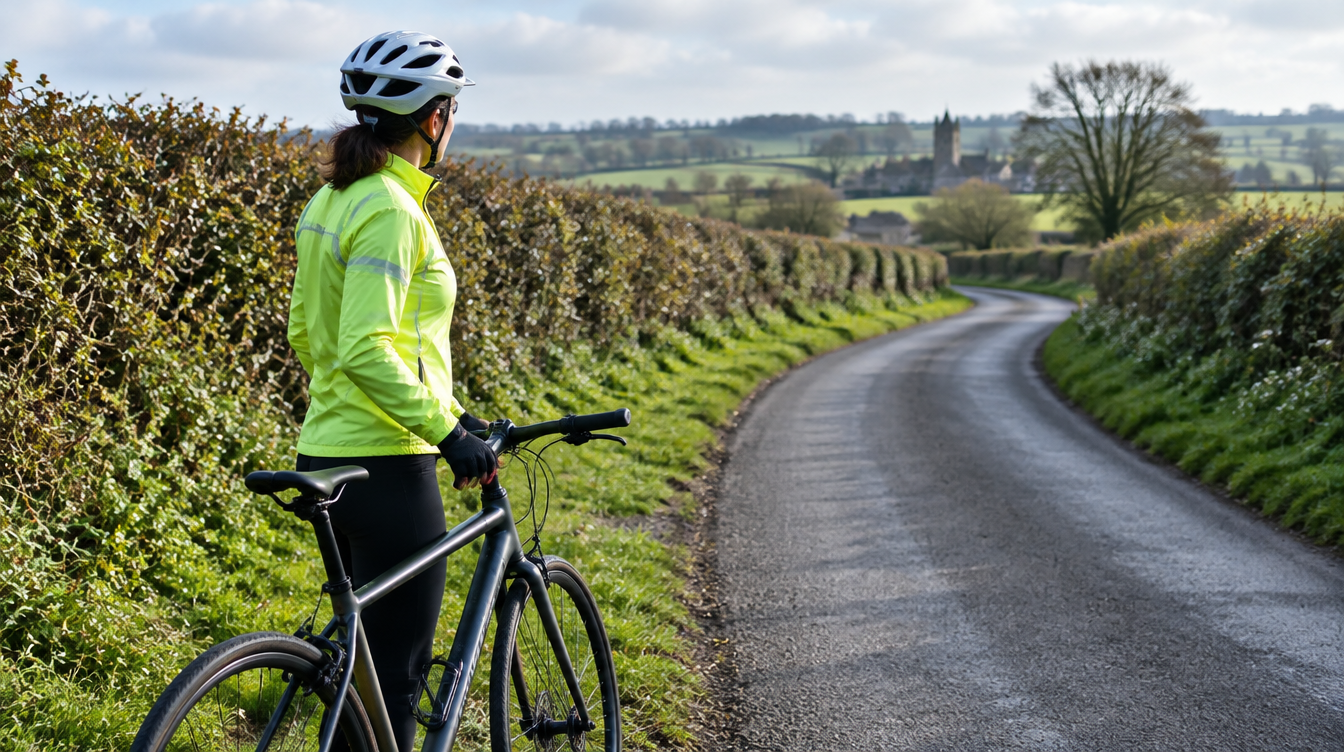
Featured image: AI-generated editorial illustration, not camera footage or product photography.
Quick answer: A riding camera can give you a record of the journey from its viewpoint, help you revisit a moment and retain footage you may want to share appropriately. It does not prevent an incident, capture everything or guarantee a police, legal or insurance outcome. Choose recording because the practical record is useful to you, then build a manageable routine around it.
You may never have had a particular incident in mind. Perhaps recording simply seems sensible, in the same unremarkable way that keeping an important receipt seems sensible. You hope the file will be uneventful; you would still like it to exist.
Or perhaps something happened and the memory is clearer in some places than others. Which vehicle arrived first? Where was the junction? What happened before the moment you remember most strongly?
A camera cannot answer every question, but it may preserve part of the scene instead of leaving you entirely dependent on recollection.
A record of ordinary journeys
Most recorded rides will contain nothing exceptional. That is a good outcome, not a failure to find content.
The commute, a shared hack or a weekend route can still be worth retaining. Footage may preserve a place, a pleasant day or the conditions of a journey. You decide which parts have value.
There is no need to watch everything or build a permanent archive of all your travel. Loop recording can help manage routine storage, while a separate habit lets you keep selected moments deliberately.
Something to revisit when memory is incomplete
People notice different parts of the same situation. Attention is rightly occupied by riding, observing and responding. Afterwards, the order and detail of events may be harder to recall.
Footage can show the part of the scene that fell within the camera’s view. It may help establish a sequence or identify a visible feature of the road. It can also reveal that an assumption made in the moment needs revisiting.
Treat it as a source of information with limits. Do not force a recording to support a preferred account or claim it contains things outside the frame.
What a camera does not record
It does not reproduce everything the rider saw, heard, felt or understood. A helmet camera follows its mounting position and head movement. A bike-mounted camera produces a different perspective.
The body, clothing, luggage, horse or other traffic can obscure information. Lighting, weather, angle and motion affect detail. Two lenses add two recorded directions, not an all-seeing account.
Those limits are not reasons to dismiss recording. They are reasons to choose and describe the view accurately. A useful record is more credible when no one pretends it is complete.
Why some riders choose two views
A front camera can show the road ahead and traffic in that direction. A rear camera can add approaching vehicles behind. An encounter may move through both areas, making the combination useful.
DC-1 and DC-2 Pro provide simultaneous front-and-rear recording from one helmet unit. HC-1 prioritises lightweight forward recording. LC-2 Pro has a different cycling role, combining a single camera view with an LED light, normally at the rear of the bicycle.
Choose the job first. A simple single view may be appropriate for one rider, while another values both perspectives. Extra coverage should serve a clear need rather than become a feature collected for its own sake.
A camera should not change the purpose of the ride
Recording is something the equipment does while you ride. It should not become a reason to seek an encounter, follow someone or take a route that feels unsuitable.
Do not operate apps or manage files while moving. Prepare settings beforehand, confirm recording and review later when safely stopped. A camera is not a substitute for observation, suitable equipment or qualified riding instruction.
The ideal routine leaves your attention available for the journey. If the setup continually demands intervention, reconsider whether the arrangement fits your need.
Retaining footage for a possible report
If something happens and you want to preserve it, follow the model guidance when safe. Keep original files and useful surrounding clips, including both views where relevant. Make separate verified copies before routine overwrite removes material.
Note the date, location and any clock discrepancy. Keep your account factual and distinguish what you personally observed from what a recording shows.
Check the receiving organisation’s current official instructions before submitting or publicly sharing material. Requirements and decisions vary. A camera’s specification does not establish that footage will be accepted or that a particular outcome will follow.
Avoid promises about other people’s behaviour
Some riders feel reassured by recording. Others may believe a visible camera affects an encounter. Those experiences should not be turned into a claim that wearing a camera will make road users act in a particular way.
The dependable product role is retaining its recorded view. That is valuable enough to explain without promising a deterrent or a prevented incident.
The same care applies to stories. One successful report, clear plate or considerate pass does not predict every future result. Use examples to understand a viewpoint and a process, not to promise a repeat outcome.
A suitable fit makes the idea practical
Check the current instructions from the helmet, riding-hat or bicycle manufacturer before attaching equipment. A supplied mount does not establish permission for every protective item.
Do not drill, cut or modify headgear to make a camera fit. Consider normal movement, fit and snagging, and use suitable advice where necessary. Test the view only after the fitting itself is appropriate.
A short ordinary recording can reveal a covered rear lens or an angle pointing mostly at the sky. It is better to find that out during a routine check than after a moment you hoped to retain.
Choose enough power and suitable storage
Plan around the full time you want recorded, with room for delays. A stated maximum runtime is not a guarantee for every setting or condition. Higher-resolution modes may have different durations.
Use a compatible memory card and follow the model’s guidance for formatting and file handling. Battery duration, card capacity and loop recording are separate constraints.
Review ordinary files occasionally. Confirm they exist, open correctly and show a useful view. A familiar checking habit contributes more to an everyday recording routine than assuming a device is always ready because it was charged last week.
Keep enjoyable moments as well as useful context
A camera can preserve a good journey without turning it into a production. Save the original clip, organise it somewhere sensible and keep a backup if it matters to you.
Before sharing, think about other people shown and the intended audience. A private memory, a public post and a formal report are different uses. Obtain appropriate permission where needed and avoid publishing claims beyond what the material establishes.
There is no requirement for every retained ride to become online content. A quiet folder of personal recordings can be the entire point.
Questions about starting to record
Do I need an incident to justify a camera?
No. Wanting a practical record is a sufficient personal reason. Choose around ordinary riding rather than feeling you need a dramatic story first.
Does footage settle disagreements automatically?
No. It is one recorded perspective, and its clarity and relevance vary. It may add information without answering every question.
Is the most expensive camera always the sensible choice?
No. Match coverage, suitable fitting and runtime to your need. A simpler arrangement you use consistently may perform the job more appropriately.
Make recording an ordinary habit
Choose the view, confirm the fit, check power and storage, then learn how to retain files. Let the camera keep its record while you keep your attention on riding.
Explore the rider-safety camera advice, real footage and camera comparison for a practical starting point. Promise a record, understand its limits and make the setup fit the ride.