
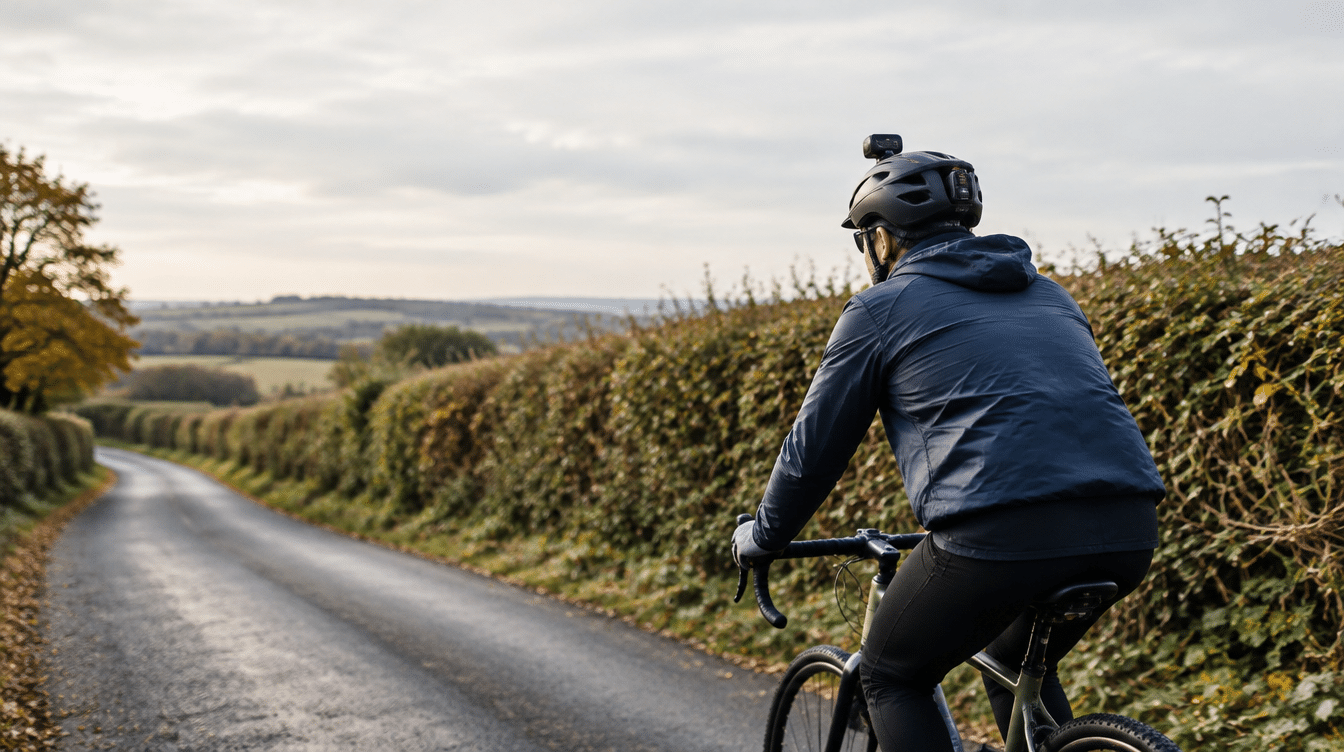
Quick answer: A front camera records the road or route ahead. A rear camera records what approaches and happens behind. Recording both directions gives you more context, but it is not the same as recording everything. The right choice depends on your rides, your mounting options and whether the setup is easy enough to use regularly.
Picture an ordinary Saturday ride. You’ve checked the weather three times, finally accepted that “a little drizzle” is still drizzle, and headed off anyway.
At the first junction, a driver edges out while you’re approaching. Later, on a narrow lane, another vehicle approaches from behind and passes. Two very different moments, both on the same journey. A camera looking ahead might help you revisit the first. A rear-facing camera might offer a more useful view of the second.
That is why “front, rear or both?” is a better first question than “How many pixels does it record?”
What does a front-facing riding camera actually see?
A front-facing camera records the direction you are travelling. Depending on where it is mounted, that may include the road surface, traffic ahead, junctions, passing places, other riders and the approach to a situation.
For a cyclist commuting across town, it can show the traffic lights and junction layout ahead. For a motorcyclist, it can capture the road and vehicles in front on a busy ride. For someone hacking out on a horse, it can show a bend in the lane or the route ahead.
There is a big practical advantage, too: one small camera can be relatively straightforward to prepare, operate and charge. And a camera you use on every ride is more useful than a complicated arrangement you only bother with on alternate Tuesdays.
But one forward-facing view has an obvious limitation: it is not looking behind you. It may capture the aftermath of a passing vehicle, or a glimpse as it moves into the frame, without showing how the vehicle approached.
What does rear-facing recording add?
A rear camera looks back along the route. It can be especially relevant where vehicles approach from behind: a commute on a busy road, a rural lane with overtaking traffic, or a long motorcycle journey with following vehicles.
It may show the approach of another road user, the position of that vehicle within the frame and part of the passing movement. That’s a different kind of context from a forward-facing view.
But a rear camera isn’t a laser measuring device. Perspective can make distances difficult to judge. Lighting, camera angle, vibration, weather, lens cleanliness and the speed of a passing vehicle affect the recording. Number plates aren’t guaranteed to be legible in every frame either.
A useful recording is still just that: a recording of what the camera could see from its particular position.
What about front and rear cameras together?
The appeal is simple: two directions, one journey. A front-and-rear camera can provide a forward view and a view of what’s approaching from behind. If an incident spans both directions, that extra context may be useful when reviewing the footage.
The important phrase here is two directions, not “every angle”. Even dual-lens cameras have blind spots. Your shoulder, helmet, horse, luggage, road furniture or a bend may block the view. Something happening directly alongside you might be outside both lenses.
There are trade-offs as well. Two-lens cameras can be bigger than a small single-lens model, and recording settings can affect battery duration and storage. That’s worth thinking about before you buy.
For Techalogic riders, the DC-1 records ahead and behind from a dual-lens helmet camera. The DC-2 Pro also records both directions, with higher-spec recording and a longer stated battery duration. More on the differences shortly.
Is rear-only recording enough?
Sometimes it may be exactly what you want, especially if you’re cycling and your main recording priority is approaching traffic behind you.
Techalogic’s LC-2 Pro is a rear-facing cycling camera with an integrated LED light, designed to mount on the bicycle’s seat post. Its job is different from a helmet-mounted dual-lens camera. It records behind and provides cycling lighting, but it doesn’t record the road ahead.
That isn’t a flaw to explain away. It’s the point of choosing a product by its job. If rear coverage and a cycling light are what matter most to you, that arrangement can make sense. If you also want a forward view, you’ll need a different setup.
Does mounting position matter as much as camera direction?
More than most people expect.
A helmet-mounted camera generally follows the movement of your head. You look towards a junction and the view changes with you. That can be useful context, although rapid head movements may also make footage less straightforward to follow.
A bike-mounted camera sees a more fixed direction relative to the bicycle. This can produce a different record of the same ride, especially when you’re turning your head but the handlebars or seat post stay aligned with the bike.
With horse riding, camera placement needs particular thought. A camera on a riding hat follows head movement; other placements produce different views. Nothing should compromise the protective equipment or create a snagging hazard. Always check your riding-hat manufacturer’s guidance before attaching a mount.
The best way to learn what your setup really captures is wonderfully unglamorous: make a short test recording. Then watch it back. You’ll quickly discover whether the lens is aimed at the road, your shoulder or the most detailed footage of your own jacket ever committed to a memory card.
What coverage makes sense for cyclists?
Start with the route, not the product catalogue.
If you mostly ride on traffic-free paths and want a straightforward record of where you’re going, front recording may be a sensible first step. If your regular journey involves overtaking traffic approaching from behind, a rear view may be particularly relevant.
If you want to record both perspectives, a dual-lens helmet camera is worth considering. But think about weight, mounting comfort and charging as well as the footage. A camera has to work with your riding routine, not create a second hobby in cable management.
For rear-only bike-mounted recording and lighting, look at the LC-2 Pro. For a lightweight forward helmet view, consider the HC-1. For both directions from one helmet-mounted camera, compare DC-1 and DC-2 Pro.
And for motorcyclists?
The same question applies, although the riding environment may differ.
On a motorway journey, you’ll be interested in traffic ahead and behind. On urban streets, junctions and changes in traffic ahead might matter more. On long rides, the stated battery duration becomes part of the decision.
Do check camera and mount compatibility with your helmet. Don’t assume that a mount suitable for one helmet is appropriate for another. Think about where the camera sits, how it affects your comfort and how easily you can confirm recording before you set off.
If you want dual-direction helmet recording, DC-1 and DC-2 Pro serve that purpose. If your priority is a lighter forward-facing setup, HC-1 has a different appeal.
What should horse riders consider?
Rural roads, bridleways and shared routes can throw up all sorts of situations. A front view records the route ahead and traffic approaching from that direction. A rear view may help show approaching or passing vehicles from behind.
But for an equestrian rider, fitting the camera sensibly is as important as what it records. Check your riding-hat manufacturer’s instructions. Make sure any equipment is secure, comfortable and doesn’t catch on clothing or tack.
Choose something you’re happy to wear on an ordinary hack. A recording system shouldn’t become the most exciting part of an otherwise peaceful ride.
Which Techalogic camera fits each job?
| Camera | Records | Good starting point if… | Honest trade-off |
|---|---|---|---|
| HC-1 | Ahead | You want lightweight, routine helmet recording | No rear view |
| DC-1 | Ahead and behind | You want accessible front-and-rear helmet recording | Shorter stated runtime than DC-2 Pro |
| DC-2 Pro | Ahead and behind | You want higher-spec dual recording and longer stated runtime | Larger than HC-1; optional extras cost more |
| LC-2 Pro | Behind | You’re cycling and want a rear camera with an LED light | One recording direction; rear-facing in the standard bike setup |
The manufacturer’s stated battery durations are up to 2.5 hours for HC-1, up to 2.5 hours for DC-1, up to 4 hours in dual Full HD at 30fps for DC-2 Pro and up to 7 hours for LC-2 Pro. Those are not guarantees of the time you’ll get on every ride. Settings, conditions and how you use the camera can change real-world runtime.
You can see the current product-by-product differences in our camera comparison or start with the camera finder.
Three questions to ask before choosing
1. Which direction do I actually want recorded? Think of your ordinary journey and the moments you’d find useful to look back on.
2. Where can I mount it safely and comfortably? Helmet, riding hat and bicycle mountings are different. Follow your equipment manufacturer’s guidance.
3. Will I keep it charged and switched on? Battery duration, card management, weather protection and simple operation matter just as much as image quality.
And after fitting the camera, record a short test clip. Make sure the card works, the lens is clean and the view matches what you intended.
The bottom line
Front recording shows where you’re going. Rear recording shows what’s approaching from behind. Two directions provide more context, but no camera can capture everything or promise a particular outcome.
Choosing well is about understanding the job, accepting the trade-offs and making recording a practical part of the ride.
That’s the Techalogic approach: useful technology and a reliable record of what happens around you—not a specification contest.
Explore the Techalogic safety camera range and compare the four different recording jobs before you decide.
Image: AI-generated editorial illustration. It does not show verified Techalogic equipment, an actual incident or a manufacturer-approved mounting arrangement.